Happy Friday! We asked ChatGPT to write the intro for today’s newsletter. Here’s what we got back:
“We’ve got a roundup of the top healthcare news stories, as well as some interesting articles and insights from around the industry. So pour yourself a cup of coffee…and get ready to dive into the latest happenings in healthcare.”
Couldn’t have said it better ourselves!
In today’s edition:
 Birth centers Birth centers
 Accountable care orgs Accountable care orgs
 Social determinants Social determinants
—Maia Anderson, Michael Schroeder
|
|
Credit: Hannah Minn
We’ve all heard that more people started working from home during the pandemic. As it turns out, the number of people giving birth at home rose, too (albeit not to the same extent).
Per CDC data, the percentage of all US births that took place at home rose to 1.26% in 2020, up from 1.03% in 2019. That’s a 22% increase—and the highest percentage of home births since at least 1990, according to the CDC.
But there’s another pool of birthing people who are looking for something in between: They don’t want to go to a hospital, but they may not feel comfortable going into labor at home either. Those patients are turning to one of about 400 freestanding birth centers, which have doubled in number over the last decade in the US, according to the American Association of Birth Centers.
Birth centers are independent healthcare facilities that have a licensed staff and provide childbirth services. They also “were a more popular choice when there were restrictions on visitors and support people at hospitals during Covid,” said Raizy Hines, a certified doula at Doula Support Los Angeles.
Childbirth is a “cash cow” for hospitals. Ge Bai, a professor of health policy and management at Johns Hopkins Bloomberg School of Public Health, said that childbirth is a “cash cow” for hospitals because it is such a frequently performed procedure.
“From a financial perspective, hospitals do not want to lose this service to at-home delivery,” Bai said.
But it’s impossible to calculate exactly how much hospitals typically make from childbirth and related services because hospitals don’t report revenue broken down by procedure, she said.
Data from the Health Care Cost Institute shows that in 2020, childbirth and pregnancy made up more than 20% of hospital admissions. And Martin said that on average, hospitals are paid about $13,000 per childbirth, though there’s a “pretty wide variation” among facilities. Keep reading here.—MA
Do you work in healthcare or have information about the industry that we should know? Email [email protected]. For completely confidential conversations, ask Maia for her number on Signal.
|
|
TOGETHER WITH GE HEALTHCARE
|
|
A new chapter begins today. As of January 4, GE HealthCare is spinning off from GE to stand alone as one of the largest medical technology companies in the world.
The name and branding may be new, but here’s what’s not: the 100-year history of compassion and care that will inform GE HealthCare’s mission to innovate healthcare.
GE HealthCare (listed as GEHC on Nasdaq) has big plans for the future. With over 300,000 patients using GEHC imaging agents every day and $1 billion invested in R&D annually, GE HealthCare is ready to think bolder and bigger to deliver connected, compassionate healthcare.
The future of healthcare is bright. Learn more about GE HealthCare and the new era of care here.
|
|
Sdi Productions/Getty Images
ACOs, or accountable care organizations, seem increasingly like the gold standard for CMS, incentivizing health systems to provide cost-efficient, quality care for an estimated 11+ million patients in 2022. And by 2030, the Biden administration wants all Medicare beneficiaries—numbering close to 64 million in 2021—to have access to “accountable care.”
ACOs are made up of doctors, hospitals, and other healthcare providers who financially benefit when their patients, often those with chronic illness, receive quality care that also controls costs by keeping patients healthier. It’s a win-win for the federal government (and private insurers who support programs similar to Medicare’s) and healthcare professionals, ensuring that “patients get the right care at the right time, while avoiding unnecessary duplication of services and preventing medical errors,” as the US Centers for Medicare and Medicaid Services (CMS) explains it.
“In the default system, [the doctor] gets paid simply based on how often they see you,” said Sean Cavanaugh, chief policy officer at Aledade, a company that helps providers band together to create ACOs. “Under an ACO, he or she gets paid based on [whether] you stay well.”
Successful ACOs that Aledade works with pay the company a cut of the shared savings they get back, said Cavanaugh, a former deputy administrator and director of CMS. Nearly all ACOs participating in Medicare’s Shared Savings Program—99%—met the quality standard required to share in those savings, according to CMS. (Those Aledade worked with that earned shared savings got back an average of $248 per patient enrolled in Medicare per year, Cavanaugh said.)
Still, economics can be an incentive or a disincentive to become an ACO. Keep reading here.—MS
|
|
Syahrir Maulana/Getty Images
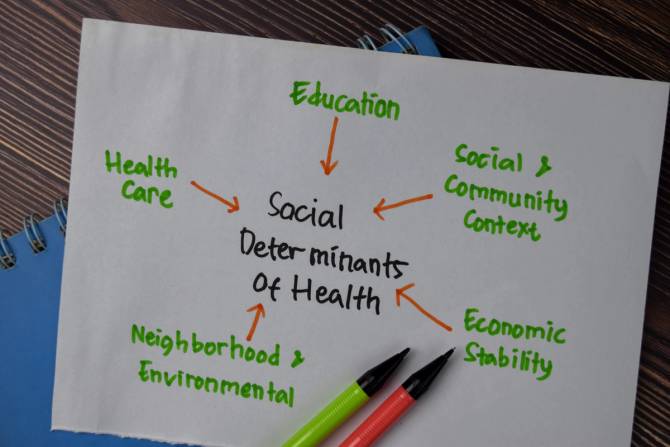
A patient’s health isn’t determined by how often they visit the doctor or how well they adhere to their drug regimen. There’s a range of nonclinical and environmental factors that contribute to a patient’s overall health, and those are called the “social determinants of health.”
“Most people think that health is 100% about healthcare—meaning what you can achieve by going to the doctor and getting regular appointments,” said Lynda Flowers, an independent health policy consultant with expertise in social determinants of health. “The literature says that only about 10% to 20% of health is determined by healthcare, which is important, but in and of itself, it doesn’t account for all of the things that impact our health.”
Examples of social determinants of health include access to safe housing, education, and secure financial resources. Exposure to racism, discrimination, and violence also affects health either positively or negatively.
Many health systems have programs to address various social determinants of health.
Medstar Health, which is based in the DC/Maryland/Virginia (DMV) area, partnered with Uber in 2019 to increase patient access to transportation to appointments. The program was implemented after the health system found that patients weren’t showing up to appointments largely because they couldn’t get to the centers.
Children’s Wisconsin, based in Milwaukee, started a program in 1996 called Project Ujima, which “works to stop the cycle of violent crimes through crisis intervention and case management" for children and adults in the community. One of the successes Children’s Wisconsin lists as a result of Project Ujima is “better medical outcomes after injury.” Keep reading here.—MA
|
|
TOGETHER WITH GE HEALTHCARE
|
|
Francis Scialabba
Today’s top healthcare reads.
Stat: “New York is considered one of the worst states in the country to be a doctor,” according to Spectrum News 1. (Spectrum News 1)
Quote: “It has to be a perfect storm of events where there’s an impact to the chest wall overlying the heart with just enough force, and what’s most critical is the timing.”—Christopher Madias, director of the New England Cardiac Arrhythmia Center at Tufts Medical Center, on the suspicion that Bills safety Damar Hamlin suffered commotio cordis after a hit during Monday Night Football (NPR)
Read: The NFL’s response to Damar Hamlin’s collapse during the Bills-Bengals game is part of the shifting landscape around athlete mental health. (the Wall Street Journal)
|
|
-
The percentage of children who accidentally ingest edibles has skyrocketed.
-
More clinics across the US are offering ketamine therapy to treat a range of mental health issues.
-
Retail pharmacies can now dispense abortion pills under a new FDA rule.
-
New York State Sen. Brad Hoylman, a Manhattan Democrat, introduced a bill that would allow mental health days to count as excused absences for public school students.
|
|
Catch up on the top Healthcare Brew stories you may have missed:
|
|
|
Written by
Maia Anderson and Michael Schroeder
Was this email forwarded to you? Sign up
here.
{if !contains(profile.lists,"Marketing Brew") || !contains(profile.lists,"Future Social") || !contains(profile.lists,"CFO Brew") || !contains(profile.lists,"HR Brew") || !contains(profile.lists,"EmTech Brew") || !contains(profile.lists,"IT Brew") || !contains(profile.lists,"Retail Brew") || !contains(profile.lists,"Healthcare Brew")}
Take The Brew to work
{/if}
{if !contains(profile.lists,"Marketing Brew") || !contains(profile.lists,"Future Social")}
-
Marketers:
{if !contains(profile.lists,"Marketing Brew")}
Marketing Brew
{/if}
{if !contains(profile.lists,"Future Social")}
Future Social
{/if}
{/if}
{if !contains(profile.lists,"CFO Brew") || !contains(profile.lists,"HR Brew")}
-
Corporate:
{if !contains(profile.lists,"CFO Brew")}
CFO Brew
{/if}
{if !contains(profile.lists,"HR Brew")}
HR Brew
{/if}
{/if}
{if !contains(profile.lists,"EmTech Brew") || !contains(profile.lists,"IT Brew")}
-
Tech:
{if !contains(profile.lists,"IT Brew")}
IT Brew
{/if}
{if !contains(profile.lists,"EmTech Brew")}
Emerging Tech Brew
{/if}
{/if}
{if !contains(profile.lists,"Retail Brew")}
-
Retailers:
Retail Brew
{/if}
{if !contains(profile.lists,"Healthcare Brew")}
-
Healthcare:
Healthcare Brew
{/if}
{if !contains(profile.lists,"Daily Business") || !contains(profile.lists,"Money Scoop") || !contains(profile.lists,"Money With Katie")}
Get smarter in just 5 minutes
{/if}
{if !contains(profile.lists,"Daily Business")}
-
Business News:
Morning Brew
{/if}
{if !contains(profile.lists,"Money Scoop") || !contains(profile.lists,"Money With Katie")}
-
Money & Career:
{if !contains(profile.lists,"Money Scoop")}
Money Scoop
{/if}
{if !contains(profile.lists,"Money With Katie")}
Money With Katie
{/if}
{/if}
Business education without the BS
Interested in podcasts?
|
ADVERTISE
//
CAREERS
//
SHOP
//
FAQ
Update your email preferences or unsubscribe
here.
View our privacy policy
here.
Copyright ©
2023
Morning Brew. All rights reserved.
22 W 19th St, 4th Floor, New York, NY 10011
|
|
 {/if}
{if !profile.vars.num || (profile.vars.num >= 0 && profile.vars.num < 60)}
{/if}
{if !profile.vars.num || (profile.vars.num >= 0 && profile.vars.num < 60)}